Coalition airstrikes hit ISIS outside Kobani, but only slow the attack

The northern Syrian border town of Kobani and surrounding villages — predominantly Kurdish — recently came under siege by ISIS tanks and artillery, as discussed previously on this site. This collapsing Kurdish enclave quickly turned into a mass exodus of at least 150,000 Syrian Kurdish civilians in a matter of days, as Turkey warily opened its border to avoid total pandemonium (and the possibility of a massacre happening so close to the border that it would probably appear on Turkish evening television news).

As U.S. airstrikes in Syria had not yet started but were increasingly seeming inevitable, I suggested that this ISIS armored unit closing in on Kobani and its relatively pro-American Kurdish population was probably going to be an early target:

Depending perhaps on Turkey’s views on the potential future threat posed by the now-beleaguered YPK [Syrian Kurd] fighters and the Kurdish villagers they are trying to protect, as well as whether the influential Iraqi Kurdish leadership is concerned about the situation — both of which have a significant voice in setting American military priorities in the region and are much friendlier to Syrian Kurds after months of ISIS advances into Iraq — ISIS tank units attacking Kurdish areas in northern, central Syria seem like a pretty tempting target for American-led coalition airstrikes on ISIS forces in Syria, once those begin in the coming weeks.

 
US-led coalition airstrikes began in Syria this past Tuesday, primarily focusing on military and administrative targets in Raqqa, the so-called ISIS “capital,” to the south (see map below). But on Saturday — day six of coalition strikes in Syria — the first sortie to relieve Kobani and the besieged Syrian Kurds was initiated.

According to the New York Times reporters on scene just across the border in Turkey, this first action appeared to have only a small effect, apart from slightly slowing the pace of ISIS shrinking its perimeter in the half-circle it had established around the town and up to the border; ISIS artillery still reached range to hit the town itself for the first time later on Saturday:

The Pentagon said on Saturday that it had conducted its first strikes against Islamic State targets in a besieged Kurdish area of Syria along the Turkish border, destroying two armored vehicles in an area that has been the subject of a weeklong onslaught by the Islamic State.
[…]
After days of pleading for air cover, Kurds watching the fighting from across the Turkish border west of Kobani were gleeful as jets roared overhead and two columns of smoke could be seen from the eastern front miles away. They hoped it meant that American warplanes had finally come to their aid.
[…]
Nearby, Syrian and Turkish Kurds cheered from hilltops dotted with fig and olive trees and army foxholes as Kurdish fighters scaled a ridge and fired a heavy machine gun mounted on a pickup truck at an Islamic State position less than a mile from them. Islamic State fighters could be seen moving from a nearby village, but seemed to be shifting tactics in a hedge against airstrikes, moving one vehicle at a time rather than in a convoy.

The fighting took place just a few hundred yards inside Syria, clearly visible from hilltop olive groves in Karaca, a frontier village on the Turkish side of the border. They fought with rocket-propelled grenades and heavy machine guns west of Kobani, the central town in the region.
[…]
On the eastern front, a Kurdish activist, Mustafa Ebdi, said from Kobani that an Islamic State command post, a tank and a cannon had been hit by the American strike. Still, hours later, Islamic State shelling hit Kobani’s main town for the first time, killing at least two people.

In a statement, the United States Central Command said that strikes around the country had been carried out with forces from Saudi Arabia, Jordan and the United Arab Emirates — it did not specify which aircraft hit which areas — and that “all aircraft exited the strike areas safely.”

 
We can probably expect more coalition airstrikes in the coming days, if the situation is not too fluid to hit from the air. The fact that ISIS positions are now visible from across the border may also make it easier to get accurate enough intelligence to target the attacks.

There is also extensive discussion — following heavy lobbying by the Obama Administration this past week — that Turkey may be about to join or support the military coalition directly attacking ISIS within Syria’s borders. This would at least involve providing air bases, if not bombers, or possibly even ground troops tasked with establishing a hypothetical refugee safe zone on the Syrian side of the border with Turkey.

The latter, far more expansive and ambitious option — which should raise a lot of questions and red flags all around — is probably less likely than some level of supporting the air operations. Those operations would probably become significantly safer for coalition pilots by dramatically shortening the flight distances required over hostile territory and Syrian air defenses.

[Our update for September 30, 2014: “ISIS still moving faster than coalition forces on Kobani; will Turkey enter?”]
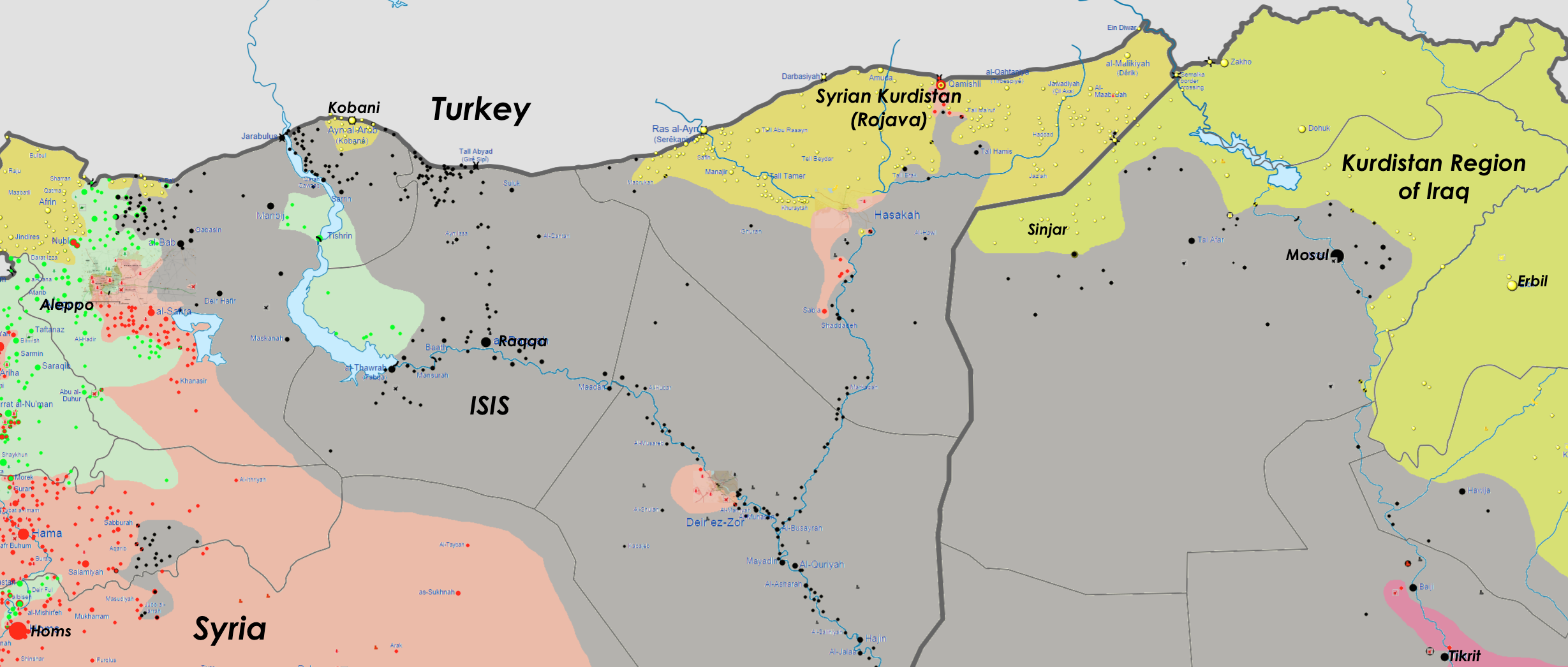
Click to enlarge: Detailed conflict map of Northern Syria and Northern Iraq, September 26, 2014, including Kobani / Ayn al-Arab. (Adapted from Wikimedia)

Click to enlarge: Detailed conflict map of Northern Syria and Northern Iraq, September 26, 2014, including Kobani / Ayn al-Arab. (Adapted from Wikimedia)


 

Kenyan sentence an urgent reminder of the need for legal abortion

A nurse has been sentenced to death in Kenya after being held responsible for the death of a young woman or girl who tried to get an abortion, back in 2009. He maintained that she had first tried to get one from unsafe source and then sought help from him as she developed complications but died anyway. The last death sentence in the country was applied in 1987.

Judge Nicholas Ombija said the court had established “that the accused caused the death of the deceased” and convicted him of murder.

 
Abortions are only legal in the country to save the life of the mother, and 120,000 women are treated annually for complications from failed attempts to obtain one illegally. The defendant is to be hanged for his role in the young woman’s death. Due to pressure by religious leaders, the law that really killed her is not expected to be changed.

Russia & UAE: A big week for women in air and space

This week saw the 4th ever female cosmonaut go into space and the first ever United Arab Emirates female combat pilot go into action in Syria.

Russia’s Yelena Serova launched into space yesterday aboard a Soyuz flight from Kazakhstan and arrived overnight at the International Space Station. She is the first woman in Russia’s space program to go to space since Yelena V. Kondakova‘s space shuttle flight (STS-84, Atlantis) in May 1997, which went to the Mir station.

Kondakova, now a member of the Russian Duma (parliament) for the ruling party, went to space twice during her career as a cosmonaut, but was actually only the 3rd ever Soviet or Russian female cosmonaut — making Serova the 4th in the entire program’s history. The Soviet Union, notably, sent a woman into space two decades before the U.S. did the same, but failed to capitalize on that milestone (not even sending its second until 19 years later). This stands in contrast with the opportunities opened to many women in NASA and space programs around the world since then.

In another part of the world, the United Arab Emirates announced on U.S. television that their pioneering female combat pilot, Major Mariam Al Mansouri, led the UAE’s airstrikes on ISIS positions in Syria, as part of the US-led coalition:

[UAE Ambassador to the US] Al Otaiba also confirmed that Major Mariam Al Mansouri, 35, an F-16 pilot, will lead the air strike missions on ISIL.

“I can officially confirm that the UAE strike mission on Monday night was led by female fighter pilot Mariam Al Mansouri,” he said.

“She is a fully qualified, highly trained, combat-ready pilot and she is on a mission.”
[…]
Maj Al Mansouri has an undergraduate degree in English literature and is the first woman to join the Khalifa bin Zayed Air College, graduating in 2008.

 
She is expected to continue commanding the UAE’s missions in Syria in the coming days and weeks.

Ambassador Al Otaiba cited her as a positive example of how Arab states and Muslim societies can be more moderate and open than the stereotype, while retaining their identities. The example was offered in contrast to both ISIS and some of the Emirates’ neighboring countries. You can read more about Major Al Mansouri and her path to the skies here.

Cosmonaut Yelena Serova (via NASA/Wikimedia) and Maj. Mariam al-Mansouri (via WAM/The National)

Cosmonaut Yelena Serova (via NASA/Wikimedia) and Maj. Mariam al-Mansouri (via WAM/The National)

Is the US-led Syria operation vs ISIS legal under international law?

The BBC published a huge, multi-angle international law analysis by Marc Weller, Professor of International Law at University of Cambridge, on whether and to what extent the US-led operations against ISIS are legal under international law without United Nations approval. It’s a very well-balanced examination, with various arguments raised both ways for each specific element (such as operations inside Syria versus inside Iraq, or the legitimacy/sovereignty questions surrounding the governments of both Syria and Iraq).

Below is an excerpt specifically regarding the legal case for narrow military operations against ISIS, within Syria, without UN approval, on behalf of Iraq — the position that I find most plausible if any case can be made at all:

According to a ruling of the International Court of Justice in the 1986 Nicaragua case, where the US was found guilty of violating international law by supporting armed Contra rebels, self-defence could only be invoked by Iraq against Syria if IS acts as a direct agent of Damascus and under its operational control.

This is not the case. Instead, the Syrian government has lost all control over the parts of Syria held by IS.

Indeed, until very recently, it has made no attempt to dislodge it, leaving this task instead to the armed opposition groups. Damascus is manifestly unable or unwilling to discharge its obligation to prevent IS operations against Iraq from its own soil. Syria cannot impose the costs of its inaction or incapacity in relation to IS on neighbouring Iraq.

Hence, under the doctrine of self-defence, the zone of operations of the campaign to defeat IS in Iraq can be extended to cover portions of Syria beyond the control of the Syrian government.

[…] short of forming an unsavoury alliance with the Assad government, the strongest legal basis for action against IS in Syria is ancillary to the campaign now being conducted in Iraq. This may also extend to other affected states, such as Jordan. The theatre of operations may extend to parts of Syria as may be strictly necessary to conclude that campaign successfully.

 
If they want to shake off the comparison to George W. Bush’s 2003 invasion of Iraq and want to make this Syrian operation have a veneer of legality, the Obama Administration should say over and over again something along these lines:
We have been requested by the sovereign government of Iraq to halt and destroy a non-state combatant force attacking them from across the Syrian border. The government of Syria has not only failed to prevent the establishment of and cross-border attacks by this non-state actor, but they have actively allowed them to flourish within their own borders. Therefore, we are acting to halt attacks against Iraq from inside Syria, on behalf of the government of Iraq, which lacks the capacity to defend itself from the origin point of these attacks, located within its neighbor’s territory.

I’ve made clear on this blog that I think this operation in Syria is deeply misguided and a big mistake, but I figured I’d at least look into the possible case for why this is legal, since even that has been unclear to me. The above is the best I’ve been able to piece together so far.

File photo of the United Nations Security Council.

File photo of the United Nations Security Council.

Destined to fail? The hardline-Sharia breakaway states of history

Since the 19th century, various leaders and groups across North Africa, East Africa, and the Middle East have attempted to establish brand new states with Islamist theocratic and expansionist governments. This tradition merely continues today with organizations acting in the vein of ISIS and several others today as well as a few rapidly derailed others in recent years. These efforts have fallen apart pretty easily every time, as discussed in a New York Times op-ed by David Motadel, a University of Cambridge historian, who has studied these movements.

They are formed in response to crisis, civil war, state failure, anti-colonialism, or some combination. They progress from rebel force seizing territory to seeking to establish states to expand their military capacities (via revenue collection and such), but then they make themselves into highly visible (and attackable) fixed targets, and they inevitably prove inept at governance, resulting in a rapid loss of popular support. Here’s one of several examples provided:

Equally short lived was the Mahdist state in Sudan, lasting from the early 1880s to the late 1890s. Led by the self-proclaimed Mahdi (“redeemer”) Muhammad Ahmad, the movement called for jihad against their Egyptian-Ottoman rulers and their British overlords, and it established state structures, including a telegraph network, weapon factories and a propaganda apparatus. The rebels banned smoking, alcohol and dancing and persecuted religious minorities.

But the state was unable to provide stable institutions, and the economy collapsed; half of the population died from famine, disease and violence before the British Army, supported by Egyptians, crushed the regime in a bloody campaign, events chronicled in “The River War” by the young Winston Churchill, who served as an officer in Sudan.

 
I think probably the only example of a surviving anti-colonial Islamist theocracy is Iran after 1979, which isn’t discussed in the article. But that’s because there’s not much similarity, despite the apparent end game. The Iranian radicals seized complete political power in a defined, pre-existing country with an existing and functioning state. There wasn’t a huge external crisis or war happening at the time, and they didn’t have to fight their way into power with a full-scale rebellion or insurgency. Moreover, the Iranian revolutionaries immediately turned the engine of the state (albeit with heavy purging of old regime loyalists) toward populist provision of services. And then they were soon invaded by Saddam Hussein, which helped mobilize the population for a patriotic defense against him, thus further securing the continuance of the new government in the state. In other words, the Iranians came to power very differently from how groups in the mold ISIS have tried to establish state authority, and they did everything they needed to so that they would be on a durable footing.

ISIS may be more tech-savvy and one of the best armed of these groups over the course of more than a century — though they’re also facing modern armed forces and not 19th century French infantry — but they have already shown themselves to be repeating the same patterns that led to the collapse of the prior efforts. You can alienate the people some of the time, if you provide food and services, but you can’t provide that without risking external attacks (like we’ve been seeing) or else a demonstration of gross incompetence in governing…and you can’t stop providing those things and continue alienating the people, without falling from power.

As Motadel observes near the end of his column: Read more

Pro-American Kosovo’s Syrian Jihad

15 years after a US-led NATO bombing campaign freed the predominantly Muslim province of Kosovo from Serbia, youth unemployment stands at 70%. Now more than a hundred young residents, from a country with a huge statue of Bill Clinton in the capital (photo below), have gone off to join anti-American terrorist groups in Syria and Iraq.

Balkan fighters have participated in Islamist insurgencies elsewhere in the past, but more often against Russia — which, unlike the US, supported Serbia against its Muslim neighbors in the former Yugoslavia. This time, would-be combatants from places like Kosovo are joining ISIS, a group that has moved beyond attacking places in Syria and is now staging suicide attacks in Iraq’s capital against the US-supported government — using at least one Kosovar recruit so far — and has called for attacks on U.S. and British citizens everywhere.

The talk and stories of people disappearing to the Syrian conflict from Kosovo, a country of 1.8 million people, now abound. This is especially true after Kosovar fighters began propagandizing from Syria to folks back home over social media. Even some former NATO assets have reportedly joined up to become jihadists in Syria. In another case, a man kidnapped his 8-year-old son away from his wife and went to Syria with him. Senior religious officials in Kosovo have been arrested for allegedly preaching recruitment on behalf of extremist religious groups in Syria, including ISIS.

The general population disapproves very strongly of the one or two hundred citizens who have gone to join extremist groups in Syria. But Kosovo has no jobs for the vast majority of young men. In contrast, ISIS can offer excitement and a sense of purpose, along with food provisions and payroll funds from the millions of dollars added daily to its cash reserves. And the situation is not unique. Nearby Bosnia, which also has been experiencing very high unemployment and has an even more extensive prior history of contributing recruits to Islamic extremist insurgencies all over, has seen some of its citizens be similarly lured to the civil war in Syria.

The lessons, as always, are that you can’t fix every problem with airstrikes and you can’t fight extremism without fighting poverty and joblessness. A multi-million dollar Western grant for jobs training and creation in the Balkans wouldn’t go amiss right now. Too bad they’re cutting such programs in their own countries already.

Statue of Bill Clinton in Pristina, Kosovo, November 2009. (Credit: Arian Selmani via Wikimedia)

Statue of Bill Clinton in Pristina, Kosovo, November 2009. (Credit: Arian Selmani via Wikimedia)

100th Episode! September 24, 2014 – Arsenal For Democracy 100

AFD-logo-470

Topics: Implications of the Scotland no vote, ADA non-compliance in higher ed, 100th episode celebration. People: Bill, Nate, Persephone. Produced: September 21, 2014.

Discussion Points:

– What are the implications of the Scotland referendum outcome for the United Kingdom and other European separatist movements?
– Why aren’t colleges and universities doing more to comply with the Americans With Disabilities Act?

Part 1 – Scotland:
Part 1 – Scotland – AFD 100
Part 2 – ADA Compliance, 100th Episode:
Part 2 – ADA, 100th Episode – AFD 100

To get one file for the whole episode, we recommend using one of the subscribe links at the bottom of the post.

Related links
Segment 1

Boston Globe – Opinion: On education technology, college lobbyists are keeping disabled students behind
USA Today: U.S. Justice Department sues Kent State over student’s therapy dog
CentreDaily: ADA football parking changes off to rocky start

Segment 2

BBC: Madrid opposes Catalan referendum
Financial Times: Alex Salmond brushes aside the foreign policy facts for Scotland
AFD: April 14, 2014 – Arsenal For Democracy 80, Part 2: European Nationalism

Subscribe

RSS Feed: Arsenal for Democracy Feedburner
iTunes Store Link: “Arsenal for Democracy by Bill Humphrey”

And don’t forget to check out The Digitized Ramblings of an 8-Bit Animal, the video blog of our announcer, Justin.